
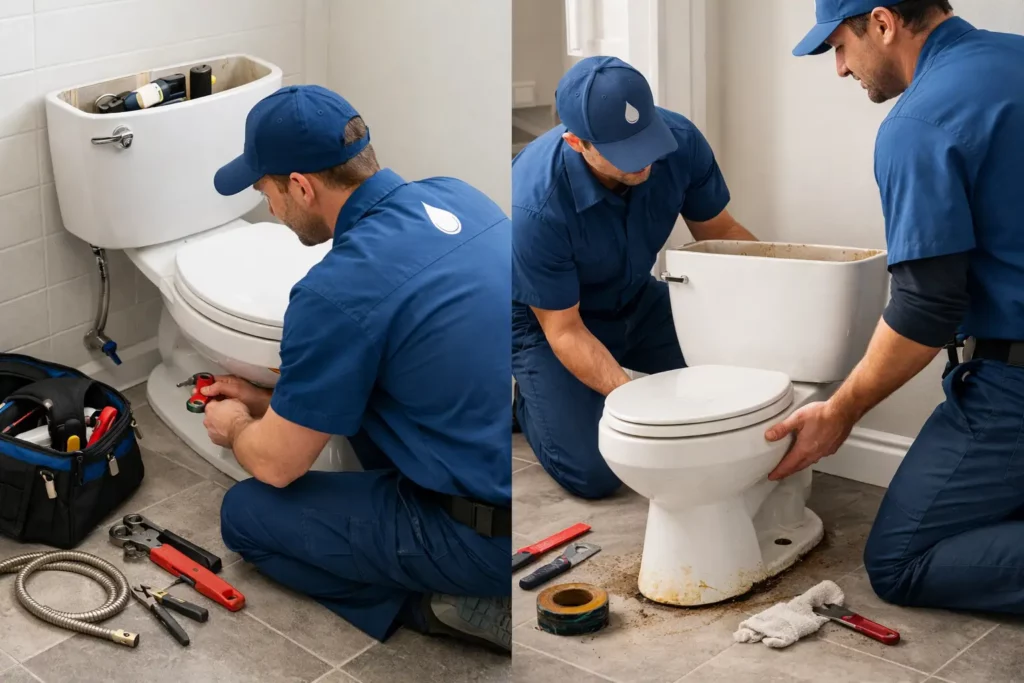
A toilet can look like a simple fixture until it starts running all night, rocks at the floor, leaks around the base, or needs a second flush every time. The right repair vs replace toilet decision comes down to the source of the problem, the toilet’s condition, and whether a repair will actually last. A small internal part can often be fixed quickly. A cracked bowl or repeated base leak is a different situation.
For Chilliwack homeowners, landlords, and property managers, the goal should not be to replace a toilet at the first sign of trouble. It should be to stop water damage, avoid repeat service calls, and make a practical decision based on what is happening at the fixture and drain connection.
When toilet repair is the sensible choice
Many toilet problems are repairable because the working parts inside the tank are designed to be replaced. A fill valve that will not shut off, a worn flapper that lets water leak into the bowl, or a faulty flush valve can make a toilet run constantly or flush poorly. These are common repairs, and replacing the right component is usually more cost-effective than installing a new toilet.
A toilet that runs intermittently is a good example. If the tank refills every few minutes with no one using it, water is likely escaping from the tank into the bowl. Often, the issue is a deteriorated flapper or a flush valve seal. Left alone, that quiet leak can waste a surprising amount of water and increase utility costs. The toilet itself may still be in excellent shape.
A weak flush also does not automatically mean replacement. The tank may not be filling to the proper level, the inlet holes under the rim may be restricted by mineral buildup, or there may be an obstruction in the toilet trapway. A professional diagnosis can separate a fixture problem from a drain problem. If more than one fixture is slow, gurgling, or backing up, the concern may be farther down the plumbing system and require drain cleaning rather than toilet work.
Repair is also usually appropriate when the toilet is secure, the porcelain is intact, and the problem is limited to one identifiable part. Replacing a handle, seat, tank bolts, supply line, fill valve, flapper, or wax seal is generally straightforward work when the surrounding fixture and floor are sound.
A new wax seal does not always mean a new toilet
Water at the base of a toilet deserves prompt attention, but it does not always mean the toilet has failed. The wax seal between the toilet and the drain flange can lose its seal over time, particularly if the toilet has shifted or the mounting bolts have loosened. A damaged seal can allow water to escape onto the finished floor with each flush.
The first job is to determine whether the water is truly coming from the base. Condensation, a leaking tank-to-bowl connection, a cracked tank, or a dripping supply line can all leave water near the toilet. Once the source is confirmed, a plumber can remove the toilet, inspect the flange and flooring, and install the appropriate new seal. If the toilet is otherwise in good condition and mounts securely afterward, repair makes sense.
Repair vs replace toilet: signs replacement is better
Replacement becomes the better investment when the toilet itself is damaged, inefficient, unstable, or repeatedly causing the same issue. Porcelain does not repair reliably once it is cracked. A hairline crack in the tank can turn into a leak without warning, while a crack in the bowl is a sanitation and safety concern. In either case, replacement is the responsible option.
A toilet should also be considered for replacement when it rocks after the mounting bolts are checked and the cause is more than a simple adjustment. Movement can damage the wax seal and may indicate a compromised flange, a deteriorated subfloor, or an uneven finished floor. The toilet can sometimes be reset after the underlying issue is corrected, but an older fixture with other problems may not be worth reinstalling.
Repeated clogs are another reason to look at the whole picture. One clog after too much paper is not evidence that a toilet needs replacing. But a toilet that regularly plugs under normal household use may have a restricted trapway, poor original flushing performance, or an internal defect. Older low-flow models, especially early versions, can be frustrating even when their internal components are working properly. A newer quality toilet may provide more reliable flushing while using water more efficiently.
For rental properties and commercial washrooms, repeat repairs have a cost beyond the part itself. A toilet that routinely runs, plugs, or leaks creates tenant complaints, interruption, and the possibility of water damage. Replacing a problem fixture can be more affordable over time than booking multiple calls for temporary fixes.
Age matters, but condition matters more
There is no fixed age when every toilet should be replaced. A well-maintained toilet can remain serviceable for decades because the porcelain body itself does not wear out like a mechanical appliance. What does wear out are seals, valves, bolts, seats, and other serviceable components.
That said, age often reveals itself through a pattern of issues. A toilet may have corroded hardware, an outdated flush design, staining that no longer cleans up well, a poorly fitting seat, and several past repairs. If it needs another major repair, replacement can be a cleaner long-term decision.
Availability is worth considering as well. Most common toilet repair parts are readily available, but some older or specialty models use components that are harder to match. If a critical part is discontinued or a repair requires several separate replacements, installing a new standard fixture can simplify future maintenance.
Do not ignore leaks around the toilet
A toilet leak is not only about the fixture. Water can travel beneath flooring and affect the subfloor before it becomes obvious in the room below. A base leak that has been present for some time may leave soft flooring, staining, odors, or a toilet that no longer sits firmly.
If water appears at the base only after flushing, stop using the toilet until the source can be checked. If clean water is leaking from the supply line or tank, shut off the toilet’s stop valve if it operates properly and arrange a plumbing repair. If the toilet is overflowing, remove the tank lid and lift the float or close the stop valve to stop the water flow. An overflow that will not stop, sewage backup, or water spreading into other areas calls for emergency plumbing service.
A professional inspection is particularly useful where there is a recurring clog with no obvious cause. The issue may be in the toilet, but it may also involve the branch drain or sewer line. Clearing only the bowl will not solve a blockage farther downstream. For stubborn or recurring drain issues, proper drain cleaning can identify and remove the actual obstruction instead of treating the symptom.
Choosing a replacement toilet that will work well
If replacement is the right call, choose the new toilet based on performance, fit, and serviceability rather than appearance alone. The rough-in measurement, which is generally the distance from the finished wall to the center of the drain, must be confirmed before purchasing. Most homes use a standard size, but exceptions exist, and guessing can leave a toilet that does not fit correctly.
Bowl height, bowl shape, and flush performance also matter. A comfort-height toilet can be easier for many adults to use, while a compact round bowl may suit a smaller bathroom. In a busy household or commercial setting, reliable clearing performance is usually more valuable than a decorative feature that complicates repairs.
Avoid choosing solely by price. An inexpensive toilet may be perfectly suitable, but quality of the flushing design, availability of replacement parts, and proper installation are what prevent many future problems. The toilet must sit level and stable, be sealed correctly at the flange, and have a secure water connection. Overtightening porcelain bolts or using makeshift shims can create problems that do not show up until later.
Get the diagnosis before buying a toilet
Before replacing a toilet because of a leak, poor flush, or recurring clog, have the cause identified. A targeted repair may give an otherwise sound fixture many more years of service. On the other hand, a cracked, unstable, inefficient, or repeatedly troublesome toilet is often better replaced before it causes flooring damage or another urgent call.
For property owners in Chilliwack, the practical choice is the one that resolves the problem for the long term. Armacom Plumbing & Heating can assess the toilet, its water connection, and the drain conditions so the repair or replacement decision is based on the work needed, not guesswork.