
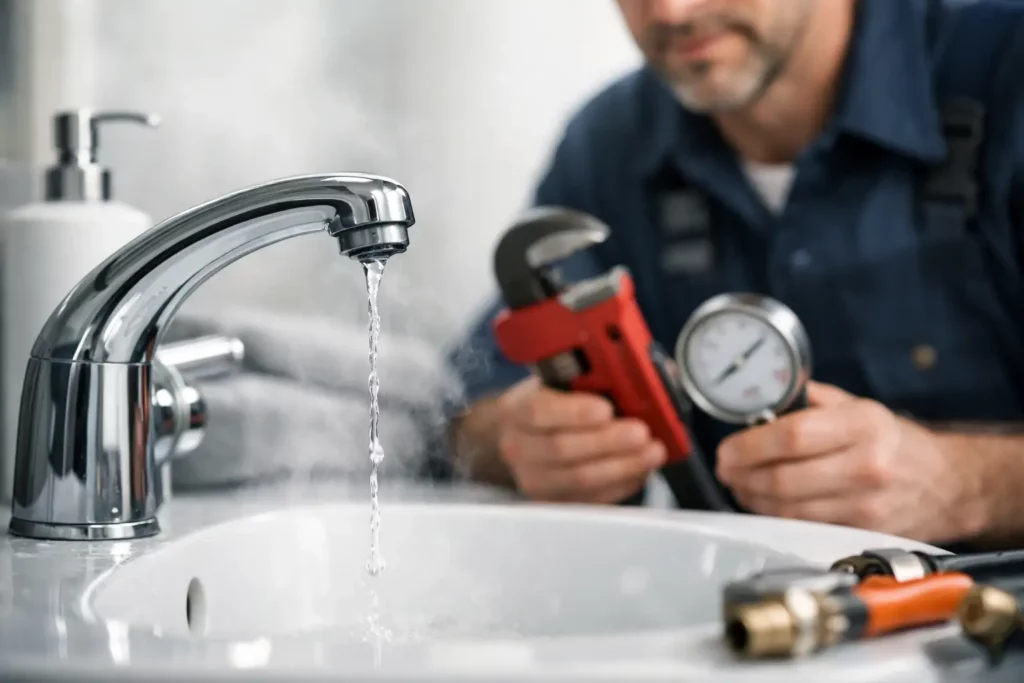
A shower that starts strong on cold but drops to a trickle when you turn up the heat is not just frustrating. Low hot water pressure often points to a restriction somewhere in the hot-water side of the plumbing system. The location of that restriction determines whether the repair is as simple as cleaning a showerhead or requires work at the water heater or inside the piping.
The useful first question is simple: does the problem affect one fixture or every hot-water faucet in the building? That observation can save time, avoid unnecessary repairs, and give a plumber a clear starting point.
What Low Hot Water Pressure Usually Means
Pressure and flow are often used interchangeably, but they are not exactly the same. Water pressure is the force pushing water through the system. Flow is the amount of water that actually makes it through a pipe or fixture. Most homeowners notice a flow problem: the shower stream is weak, the kitchen faucet takes longer to fill a pot, or the washing machine fills slowly on a hot cycle.
When cold water flows normally but hot water does not, the main incoming water supply is usually not the issue. The restriction is more likely at a fixture, a shutoff valve, the water heater, or the hot-water distribution piping.
In Mission and other Fraser Valley communities, this can be especially noticeable in homes with older plumbing, remodeled bathrooms, or water heaters that have been in service for many years. The correct repair depends on the condition of the system, not just the symptom at the tap.
Start by Checking Where the Problem Occurs
Weak hot water at one faucet or shower
If low hot water pressure affects only one fixture, start at that fixture. Mineral buildup and small pieces of worn plumbing components can collect in faucet aerators, showerheads, and cartridge screens. A partly blocked aerator can make a faucet seem like it has a major plumbing problem when the fix is simply cleaning or replacing a small part.
For a faucet, remove the aerator carefully and run the hot water briefly into a container. If the flow improves with the aerator removed, clean it or install a new one. On a shower, mineral deposits in the showerhead can restrict flow. Soaking a removable showerhead in a descaling solution may help, although an older or heavily corroded showerhead is often better replaced.
A shower valve cartridge is another common cause. Modern single-handle valves use internal cartridges to balance hot and cold water. When a cartridge is worn, damaged, or blocked by debris, hot water flow can be reduced even if the cold side is fine. Cartridge replacement is a precise repair because the water must be isolated and the correct replacement part must be fitted.
Weak hot water throughout the building
If every hot-water fixture has poor flow, cleaning one aerator will not solve the problem. Look closer to the water heater and the main hot-water piping.
First, confirm that the water heater’s cold-water supply valve is fully open. A partially closed valve can happen after service work, a water heater replacement, or an accidental bump in a tight utility room. The hot-water outlet connection should also be inspected for restrictions, corrosion, or a failed fitting.
Do not force old valves. A valve that has not moved in years can break or begin leaking when disturbed. If it is stiff, corroded, or inaccessible, it is safer to have it assessed by a plumber.
Water Heater Problems That Can Restrict Flow
A conventional tank water heater does more than heat water. It can also become the point where sediment and debris affect the hot-water system. Sediment settles at the bottom of a tank over time. In severe cases, debris can move into outlet connections or nearby piping and reduce hot-water flow.
A failing dip tube can also create trouble. This component directs incoming cold water toward the bottom of the tank. As it deteriorates, small plastic fragments may travel through the hot-water lines and clog aerators, faucet cartridges, and appliance valves. If you repeatedly find small white or plastic-like pieces in fixture screens, the water heater should be inspected.
Tankless units have different pressure-related concerns. They do not store sediment in a tank, but their internal heat exchanger and inlet screens can accumulate scale or debris. A tankless water heater that has not been maintained may deliver reduced flow, inconsistent temperature, or error codes. Proper flushing and cleaning can help, but a technician should also check that the unit is correctly sized for the fixtures it serves. A unit that cannot keep up with simultaneous demand may feel like it has poor pressure when the real issue is capacity.
Old Pipes and Hidden Restrictions
Older galvanized steel piping can corrode internally until the inside diameter becomes much smaller than the outside of the pipe suggests. The pipe may look intact from the exterior while rust buildup inside restricts flow significantly. Hot-water lines are often affected first because heat can accelerate the buildup of mineral deposits and corrosion.
This issue rarely improves on its own. Cleaning a fixture might provide short-term relief, but recurring low hot water pressure at multiple fixtures can indicate that the piping is reaching the end of its useful life. Targeted pipe replacement may work when the affected section is easy to identify. In other homes, whole-house repiping is the more practical long-term answer.
Poly-B piping presents a different concern. It does not usually cause low flow by itself, but fittings, valves, and transitions in an aging system can create restrictions or leaks. If a home has Poly-B and shows repeated plumbing concerns, it is worth evaluating the full system rather than treating each issue as isolated.
Other Causes That Need a Professional Diagnosis
A mixing valve, recirculation system, or hot-water shutoff valve can create a restriction when it fails or is installed incorrectly. Commercial buildings and multi-unit properties may have additional components, such as booster systems and larger circulation loops, that require a more methodical diagnosis.
Cross-connections can also cause unusual hot-water behavior. For example, a failed single-handle faucet cartridge can allow cold water to interfere with the hot-water side of the system. The symptoms may include weak hot flow, lukewarm water at several fixtures, or temperature changes that do not make sense based on the water heater setting.
These are not repairs to guess at. A plumber can isolate sections of piping, test flow at the water heater, inspect valves, and determine whether the restriction is local or system-wide. That approach prevents replacing a water heater when the actual problem is a blocked fixture or deteriorating pipe.
When to Call for Service
Call for professional help when low hot water pressure affects more than one fixture, appears suddenly, returns after you clean fixture screens, or comes with discolored water, leaks, banging pipes, or inconsistent temperature. Businesses should act quickly if hot-water flow affects handwashing stations, kitchen equipment, tenant spaces, or customer restrooms.
For property managers, recurring hot-water complaints deserve more than a quick fixture repair. Document which suites or fixtures are affected, when the issue began, and whether cold water is normal. That information helps isolate the cause faster and supports a repair plan that addresses the building rather than repeatedly responding to the same complaint.
Avoid turning up the water heater temperature to compensate for weak flow. Higher temperature does not restore pressure, and it can increase scalding risk. Likewise, avoid using harsh chemical cleaners in plumbing lines. They can damage components and will not correct a failed valve, corroded pipe, or restricted water heater connection.
A clear diagnosis is the fastest route to a lasting repair. Whether the cause is a clogged cartridge, a neglected water heater, or aging hot-water piping, Armacom Plumbing & Heating can identify the restriction and recommend work that fits the condition of your home or building.