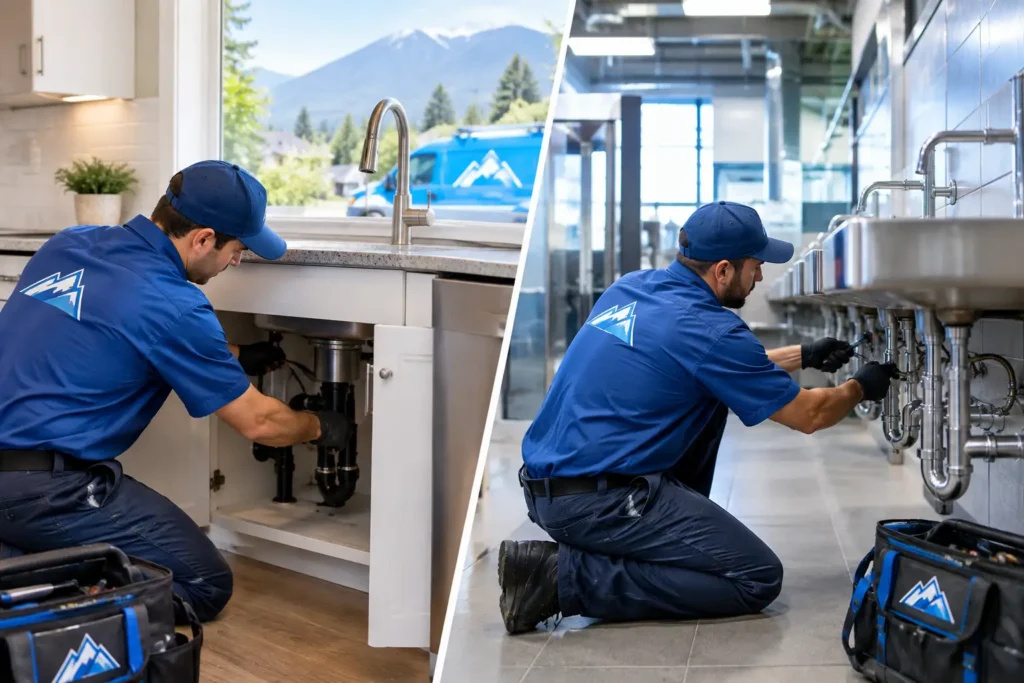
A leaking toilet in a house and a leaking toilet in a restaurant may look like the same call at first. In practice, residential vs commercial plumbing involves different systems, demands, risks, and repair priorities. The right approach protects the building, the people using it, and the owner’s budget.
For Chilliwack homeowners, the concern is usually restoring water, drainage, or hot water quickly without creating a larger repair. For property managers and business owners, plumbing work also has to account for tenant disruption, staff safety, operating hours, multiple fixtures, and the cost of downtime. Both need skilled workmanship, but the job conditions are rarely identical.
Residential vs Commercial Plumbing: The Main Difference
Residential plumbing serves a single home, duplex, townhouse, apartment unit, or mobile home. The system is generally smaller, has fewer fixtures, and is used by a predictable number of people. Common calls include a dripping pipe, blocked kitchen drain, running toilet, failed hot water tank, low water pressure, or an active water leak.
Commercial plumbing serves business spaces and multi-unit properties such as restaurants, retail stores, offices, warehouses, rental buildings, and strata common areas. These systems often have more washrooms, longer piping runs, higher fixture use, and more complex shutoff arrangements. A problem in one area can affect employees, customers, tenants, or an entire section of the building.
The basic principles remain the same: supply lines need to deliver clean water at proper pressure, drains need to carry wastewater away, and fixtures need to operate reliably. What changes is the scale of the system and the consequences when something fails.
System Size and Daily Wear
A typical house may have one to three bathrooms, a kitchen, laundry connections, and one water heater. A commercial property can have dozens of toilets and sinks, several staff areas, and equipment that depends on consistent water or gas service. More use means more wear on valves, fixtures, drain lines, and water heaters.
Residential drain problems are often isolated. A homeowner may notice one slow shower drain or a kitchen sink that backs up when the dishwasher runs. In commercial buildings, repeated use can create broader issues. Several toilets draining slowly, recurring backups in public washrooms, or water coming up from a floor drain can point to a larger blockage or a drainage problem that needs prompt attention.
Drain cleaning is a good example of where context matters. A minor residential clog may be limited to one fixture branch. At a commercial property, the plumber needs to determine whether the issue affects a single fixture, a washroom group, or a main building drain. Professional drain cleaning and hydro jetting can clear buildup in suitable drain lines, but the appropriate method depends on the pipe material, condition, blockage, and layout.
Access, Scheduling, and Business Interruption
Residential plumbing repairs are often scheduled around the homeowner’s availability. The work may require shutting off water to one fixture or, in some cases, the whole home. A good plumber explains what will be shut down, how long the interruption is expected to last, and whether the repair should be completed immediately.
Commercial work requires more coordination. Shutting down water in a restaurant during service, closing a washroom in a retail space, or interrupting a tenant’s water supply can affect revenue and operations. Property managers may need to notify occupants, arrange building access, or schedule work outside busy periods.
That does not mean every commercial repair should wait until after hours. An active leak, sewage backup, loss of water service, or overflowing fixture can become a health, property-damage, and business-continuity issue. Emergency plumbing decisions should be based on the severity of the problem, not just the calendar. Stopping water damage early is usually less costly than repairing soaked finishes, damaged inventory, or affected suites later.
Equipment Is Chosen for the Application
Residential and commercial plumbing fixtures may perform the same task, but they are not always built or sized the same way. Commercial toilets, faucets, valves, and water-heating equipment are often selected for heavier use and easier service in public or shared settings. The piping may also be larger to support more simultaneous demand.
Water heating is one of the clearest differences. A home may be well served by a properly sized hot water tank or a tankless water heater, depending on household demand, available fuel, installation conditions, and the owner’s priorities. A commercial property may need a larger-capacity system, more recovery capability, or multiple units to keep up with demand throughout the day.
Bigger is not automatically better. Oversizing can add unnecessary installation and operating costs, while undersizing leads to complaints, reduced performance, and premature wear. Whether the project is a hot water tank replacement for a home or water-heating work for a business, sizing should be based on actual use rather than guesswork.
Codes, Permits, and Safety Requirements
Every plumbing project needs to meet applicable building requirements and manufacturer installation instructions. Commercial projects can involve more detailed planning because the building use, fixture count, occupant load, and system design may create additional requirements.
For owners, the practical takeaway is simple: do not treat commercial plumbing as a larger version of a household repair. Material selection, pipe sizing, venting, drainage layout, shutoff access, and gas-fitting work all need to suit the specific property and use. Work that appears functional on day one can cause ongoing maintenance trouble if it was not designed or installed correctly.
This is particularly relevant during tenant improvements, renovations, fixture additions, or upgrades to aging piping. An experienced plumber can identify whether the existing system has the capacity for the planned change and whether worn components should be addressed at the same time.
Repair Priorities Are Different, Too
In a house, a small leak under a bathroom sink might be inconvenient but manageable for a short period if it is contained. In a commercial unit, that same leak may damage stock, create a slip hazard, affect a neighboring tenancy, or run unnoticed after business hours. The repair priority rises quickly when more people and more property are exposed.
Landlords and strata managers also have a different responsibility than a homeowner living in a single house. They may need clear information about where the issue is located, which units or common areas are affected, what repair options are available, and what steps will reduce repeat problems. Documentation and communication matter because several people may be involved in approving and coordinating the work.
For both residential and commercial customers, leak detection is valuable when the source is not obvious. Water staining, musty odors, unexplained moisture, reduced water pressure, or an unusually high water bill can all justify a professional assessment. Finding the source before opening walls or replacing finishes can keep the repair focused and reduce unnecessary damage.
When Light Commercial Plumbing Needs a Specialist Mindset
Many Chilliwack businesses operate in smaller commercial spaces, but “light commercial” does not mean low stakes. A café, office, salon, retail shop, or small multi-unit property may have a relatively compact system while still depending on it every day. A single out-of-service washroom or hot-water failure can be enough to disrupt operations.
The most effective approach is practical and preventive. Address recurring drain issues instead of repeatedly treating the symptom. Repair a running toilet before it wastes water for months. Replace failing shutoff valves when access is already available. If older Poly-B piping is present, discuss the condition of the system and a sensible replacement plan before a failure forces an emergency decision.
Commercial owners should also keep basic plumbing information available: the location of main water shutoffs, the areas served by each shutoff where known, access instructions for mechanical rooms, and the contact details for a qualified local plumber. That preparation does not prevent every emergency, but it can shorten the response when time matters.
Choosing the Right Plumbing Contractor
Whether the property is residential or commercial, look for a plumber who asks useful questions before recommending work. The fixture or area affected, when the problem started, whether it is recurring, what else is connected to the line, and whether water damage is present all help shape an accurate diagnosis.
For commercial jobs, the contractor should also understand the operational side of the work. That includes coordinating access, isolating the affected area where possible, communicating clearly about downtime, and completing repairs with long-term serviceability in mind. The least expensive immediate option is not always the best value if it leaves an old failure point in place.
Armacom Plumbing & Heating works with homeowners, landlords, property managers, and light commercial customers in Chilliwack, with the same focus on clear diagnosis, careful repairs, and dependable results.
A plumbing problem does not need to become a major interruption to deserve attention. Whether it is a household leak or a commercial drain issue, timely professional service gives you a clearer path forward and a better chance of avoiding the next call.