
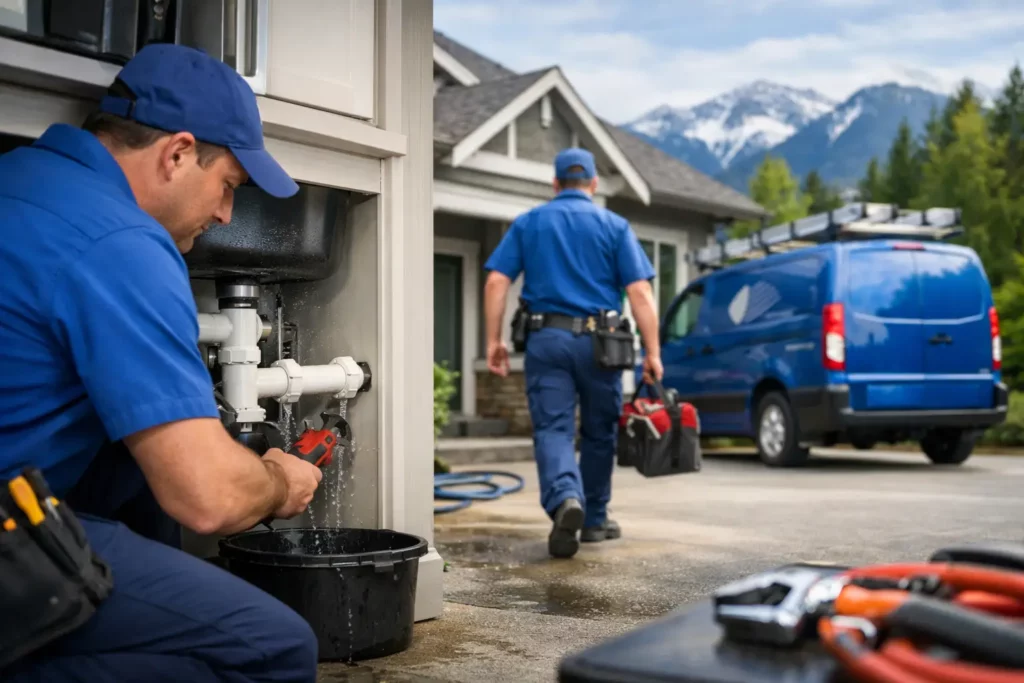
A burst supply line under a kitchen sink can put several gallons of water into cabinets and flooring before anyone finds the shutoff valve. In that situation, emergency plumber response time matters, but the first few minutes matter just as much. Knowing how an emergency call is assessed, what can affect arrival, and how to limit damage while help is on the way puts Chilliwack property owners in a far better position.
What counts as a plumbing emergency?
A plumbing emergency is not simply a problem that is inconvenient. It is a condition that is actively causing damage, creates a health concern, leaves a property without an essential service, or is likely to worsen quickly if it is left alone.
An active water leak that cannot be isolated is an emergency. So is a sewer backup entering a basement, bathroom, commercial kitchen, or occupied suite. A broken water line, an overflowing toilet that will not stop, or a hot water tank leaking heavily from its base also needs prompt attention.
Other issues may still need fast plumbing repair without requiring an emergency dispatch. A slowly dripping faucet, one clogged sink, or a toilet that flushes poorly can usually be scheduled during regular service hours. No hot water is often urgent, particularly for a rental property or business, but the right response depends on the cause, the weather, and whether the tank is leaking.
If you smell gas, leave the building, avoid operating switches or creating a spark, and contact the gas utility or emergency services from a safe location. Do not remain inside to investigate the source.
Emergency plumber response time: what affects it?
There is no responsible single answer to how fast an emergency plumber can arrive. Conditions change throughout the day, and an accurate estimate depends on the details of the call. A professional dispatcher should tell you what they know rather than promise an arrival time they cannot control.
The severity of the problem is the first factor. A home with water actively flowing through a ceiling requires a different level of urgency than a fixture leak that has been shut off and contained. Sewer backups, significant water leaks, and failures affecting multiple tenants or a business operation may require immediate triage.
Current call volume also matters. During cold weather, frozen or split pipes can create several urgent calls at once. Heavy rain can expose drainage and sewer issues. A qualified plumber may be completing another emergency where water must be shut down before they can safely leave for the next property.
The information provided at the time of the call has a practical effect too. A clear description lets the plumber arrive prepared with likely repair materials, diagnostic equipment, and the right tools. For example, a suspected main water line leak, a failed toilet shutoff, and a blocked sewer each call for a different starting point.
Access can add time after arrival. In a strata, rental building, or commercial property, the technician may need access to a mechanical room, suite, crawl space, cleanout, or water shutoff. Keeping keys, gate codes, and an authorized contact available helps avoid delays.
The goal is to stop the damage first
On an emergency call, the first objective is normally to make the property safe and stop the immediate loss. That may mean isolating a fixture, shutting off the building water, stopping a toilet overflow, or locating a leak with precision.
A permanent repair can sometimes be completed in the same visit. In other cases, the right course is to stabilize the situation, order a specific part, arrange access to a concealed pipe, or return when a larger repair can be completed properly. That is not a shortcut. It is often the soundest way to prevent a repeat failure or unnecessary damage to finished surfaces.
What to tell the plumber when you call
A short, accurate description helps move an emergency call along. Start with whether water or sewage is actively escaping, where it is appearing, and whether you have already shut off the water.
Have these details ready if possible:
- Your Chilliwack property address, unit number, best callback number, and any access instructions.
- The fixture or area involved, such as a hot water tank, toilet, kitchen sink, ceiling, crawl space, or exterior water line.
- Whether the water is clean, dirty, or sewage-contaminated, and whether it is still flowing.
- The steps already taken, including closing a fixture valve or the main water shutoff.
- Any conditions that affect safety or access, such as water near electrical equipment, a locked utility room, tenants on site, or a business that must remain open.
Photos or a brief video can be useful when requested, especially for a visible leak or overflow. They do not replace an inspection, but they can help a plumber understand the situation before arriving.
What to do while waiting for emergency plumbing help
Once you have called, focus on containment rather than trying several repairs. Improvised work can turn a manageable leak into a larger failure.
Shut off the water if you can do it safely
For a leaking toilet, sink, or washing machine connection, there may be a local shutoff valve nearby. Turn it clockwise gently. If the valve will not move, do not force it. A seized valve can break and increase the leak.
If water is coming from a hidden pipe, ceiling, or multiple fixtures, use the main water shutoff if you know where it is. Many homes have it near the water entry point, utility area, crawl space access, or hot water tank area. Landlords and property managers should ensure the main shutoff is clearly identified for tenants and staff.
Keep people away from the affected area
Water near outlets, panels, appliances, or extension cords can create a serious hazard. Do not stand in water to reach an electrical device. If it can be done safely without approaching water, turn off power to the affected area at the electrical panel. Otherwise, wait for appropriate emergency assistance.
For a sewer backup, keep people and pets out of the contaminated space. Do not run faucets, flush toilets, use a dishwasher, or start laundry. Adding more water to the drainage system may worsen the backup.
Catch and document, but do not conceal the problem
Place a bucket or towels beneath a small accessible drip if it is safe to do so. Move valuables and furniture away from the area. Take photos of the original damage before extensive cleanup, particularly in a rental, strata, or commercial property.
Avoid opening walls, cutting pipe, or applying sealants to a pressurized leak. Also avoid chemical drain cleaners during a backup. They rarely solve a serious blockage and can leave corrosive chemicals in the line for the person who must inspect it. Professional drain cleaning may involve mechanical equipment, camera inspection, or hydro jetting when the line condition and blockage call for it.
Why fast diagnosis matters as much as fast arrival
Two leaks can look identical from the living room while having very different causes. Water at the base of a toilet may be from a loose supply connection, a failed shutoff, a damaged tank component, or a drain seal issue. Water staining on a ceiling may originate directly above it, but it may also travel along framing from a bathroom, water line, or appliance connection farther away.
This is why emergency plumbing should not be treated as a guessing game. The right repair starts with finding the source, isolating the system involved, and checking for related damage or conditions that could cause the problem to return. Leak detection is particularly valuable when water is hidden behind finishes, below flooring, or within a crawl space.
For older properties, a failure can also reveal a broader issue. Repeated leaks in aging Poly-B piping, for example, may warrant a conversation about planned replacement rather than waiting for another emergency. A single repair may be appropriate, but repeated weak points deserve a longer-term solution.
Response planning for rentals and businesses
Property managers, landlords, restaurants, and commercial owners can reduce disruption by planning before the next emergency. Keep current shutoff locations documented, make sure authorized contacts can grant access, and tell occupants which situations require an immediate call.
A restaurant with a blocked main drain has different operational concerns than a homeowner with a leaking toilet, but both benefit from early reporting. Waiting until water is on the floor, fixtures are backing up, or customers are affected usually increases cleanup and downtime.
Armacom Plumbing & Heating approaches emergency calls with the same priorities: assess the risk, stop the immediate problem, explain the repair options clearly, and complete durable work where conditions allow. The most useful emergency plumber response time is one paired with the right diagnosis and a repair that addresses the actual cause.
When a leak, backup, or failed fixture threatens your property, act early. Shut off water where safe, protect the area, provide clear details when you call, and let a qualified plumber take it from there before a small failure becomes a larger repair.