
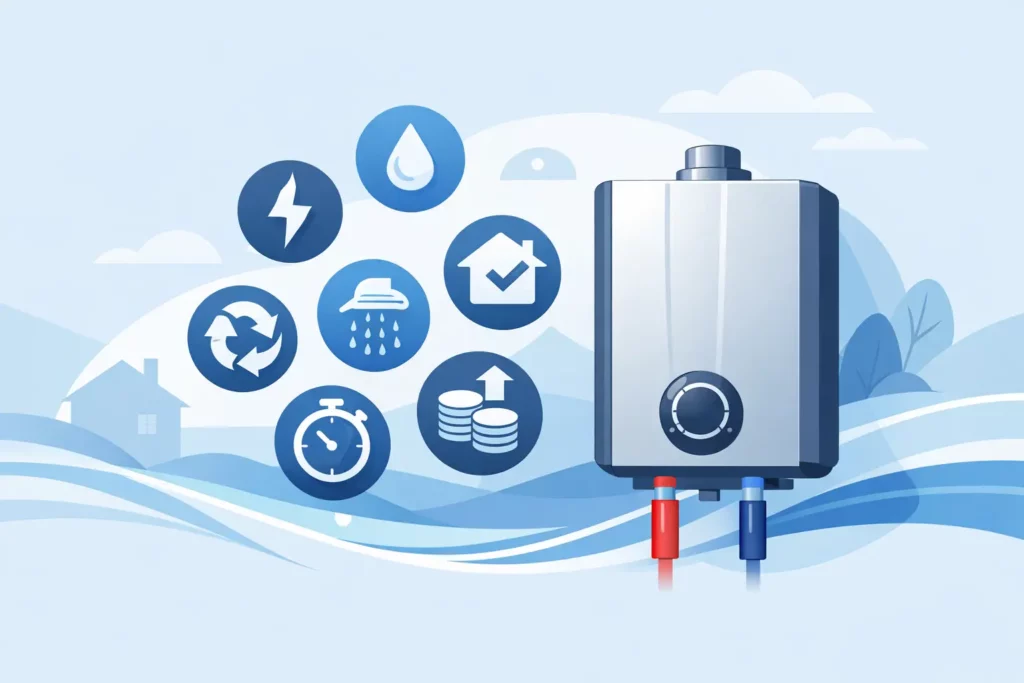
Running out of hot water halfway through a shower is usually what starts the conversation. For many homeowners and property managers, the real question is whether the tankless water heater benefits are worth the higher upfront cost. In many homes, they are. But like any plumbing upgrade, the right answer depends on your building, your water use, and how long you plan to stay in the property.
Why homeowners look at tankless water heater benefits
A traditional tank water heater stores and reheats a set amount of water all day. A tankless unit works differently. It heats water as you need it, which changes how your system uses energy, how much space it takes up, and how it performs during busy mornings.
That difference is why tankless systems appeal to households that want better efficiency and more consistent hot water. They can also be a strong fit for renovations, secondary suites, newer builds, and properties where mechanical room space is tight.
Still, tankless is not automatically better in every situation. The benefits are real, but the installation has to be matched to the home and the demand placed on it.
1. You get hot water on demand
The benefit most people care about first is simple: a properly sized tankless system can keep producing hot water without relying on a storage tank. That means no waiting for a tank to refill and reheat after a few back-to-back showers.
For larger families, homes with soaker tubs, or properties with multiple bathrooms in regular use, this can make a noticeable difference in day-to-day comfort. It is especially useful when hot water demand happens in waves, like early mornings or evenings.
That said, “endless hot water” does not mean unlimited output. A tankless unit still has a flow rate limit. If several fixtures are running at once, the system has to be sized correctly or you can still run into performance issues. This is where professional assessment matters.
2. Lower energy use over time
Among the biggest tankless water heater benefits is improved energy efficiency. Because the unit heats water only when needed, it avoids the standby energy loss that comes with keeping a large tank hot around the clock.
For households with moderate hot water use, that can translate into lower utility costs over time. In commercial or multi-use settings, the savings depend more heavily on usage patterns, system sizing, and fuel type, but efficiency is still a major reason many owners consider the switch.
The trade-off is that the savings are usually gradual, not instant. A tankless unit often costs more to buy and install, so the value shows up over years of use rather than in the first month.
3. A smaller footprint frees up space
Traditional water heaters take up floor space, and not every property has plenty of it. Tankless systems are compact and wall-mounted, which can open up room in utility closets, mechanical areas, basements, or service spaces.
For homeowners finishing a basement, updating a smaller home, or trying to make better use of a condo or suite layout, that extra space can be a practical advantage. Property managers and builders also appreciate this in tighter utility rooms where every inch matters.
The benefit is straightforward, but placement still matters. Venting, gas line capacity, electrical requirements, and service access all need to be considered before installation.
4. Longer service life is possible
A well-maintained tankless water heater can often last longer than a conventional tank model. That longer service life is one reason some property owners see it as a smart long-term upgrade rather than just a comfort upgrade.
Part of the advantage comes from how the system is built. Tank water heaters are constantly holding water, and over time that can lead to corrosion and sediment-related wear inside the tank itself. A tankless unit does not have the same storage tank vulnerability.
But this is not a maintenance-free system. In areas with hard water, regular descaling is important. If maintenance is skipped, performance can drop and components can wear faster. The longer lifespan is real, but it depends on proper care.
5. Reduced risk of a major tank leak
One of the less talked-about tankless water heater benefits is risk reduction. A traditional tank holds dozens of gallons of water, and when that tank fails, the result can be a significant leak and costly water damage.
A tankless system does not store that same volume of water, which removes one of the bigger failure points in many homes. That can offer peace of mind, especially in finished basements, utility areas near storage, or properties where leak damage could disrupt tenants or operations.
This does not mean tankless units cannot leak. Any plumbing appliance can develop issues at valves, fittings, or internal components. It simply means the classic full-tank rupture scenario is off the table.
6. Better fit for modern high-efficiency homes
Tankless systems often make sense in newer homes and carefully planned renovations because they align well with modern efficiency goals. If a home already has upgraded plumbing, proper gas capacity, and a layout designed around compact mechanical equipment, tankless installation can be a natural next step.
This is also true for additions, carriage homes, and some secondary suites where owners want reliable hot water without giving up valuable floor space. In these cases, a tankless setup can support the overall design rather than forcing the design to work around a bulky tank.
For older homes, the answer is more mixed. If gas lines, venting, or electrical systems need significant upgrades first, the project cost can rise quickly. That does not rule tankless out, but it changes the value equation.
7. Consistent performance for the right application
When installed correctly, a tankless water heater can provide steady, reliable performance for years. That is especially valuable for busy households, rental properties, and small commercial spaces where hot water reliability affects daily routines and tenant satisfaction.
Consistency comes from matching the unit to the real demand of the property. A system that is too small can struggle during peak use. A system chosen with the right capacity, proper installation, and routine service is much more likely to deliver the results people expect.
This is where experience counts. A contractor should look at fixture count, occupancy, fuel source, incoming water temperature, and expected simultaneous use before recommending a unit.
When tankless water heater benefits may not outweigh the cost
Tankless is a strong option, but it is not always the most cost-effective one. If your current hot water demand is low, your existing setup works well, and your replacement budget is tight, a quality tank water heater may still be the better short-term choice.
The same goes for older properties where installation would require extensive changes to gas lines, venting, or electrical service. In those cases, the extra investment may not pay off as quickly, especially if the home is being sold soon or the upgrade is not part of a larger renovation.
There is also a comfort factor to consider. Some users notice a slight delay before hot water reaches the tap, and in certain applications a recirculation setup may be worth discussing. These are not deal-breakers, but they are part of making an informed decision.
Choosing the right system matters as much as the product itself
A tankless water heater is only as good as its sizing and installation. The unit has to match the home, the plumbing has to be configured properly, and the venting and fuel supply need to meet code and performance requirements.
That is why the best results come from treating this as a full system decision rather than a simple product swap. Homeowners and property managers who take the time to assess actual hot water demand usually end up happier with the outcome than those who choose based on price alone.
For clients across the Fraser Valley, Armacom Plumbing often sees the same pattern: when the system is selected for the property and installed with care, tankless can be a durable, efficient upgrade that improves everyday use without adding unnecessary maintenance headaches.
Is a tankless water heater worth it?
If you want more available hot water, better energy efficiency, less mechanical room clutter, and a system built for long-term performance, tankless can be well worth considering. If your home has limited demand or would need major infrastructure upgrades first, the answer may be less clear.
The smart move is to look beyond the sales pitch and focus on fit. A good plumbing upgrade should solve a real problem, perform reliably, and make sense for the property you own. When that is the standard, tankless becomes a practical decision instead of a trend purchase.
If you are weighing your options, start with the basics: how much hot water you actually use, how your current system performs, and what kind of long-term value matters most to you.