
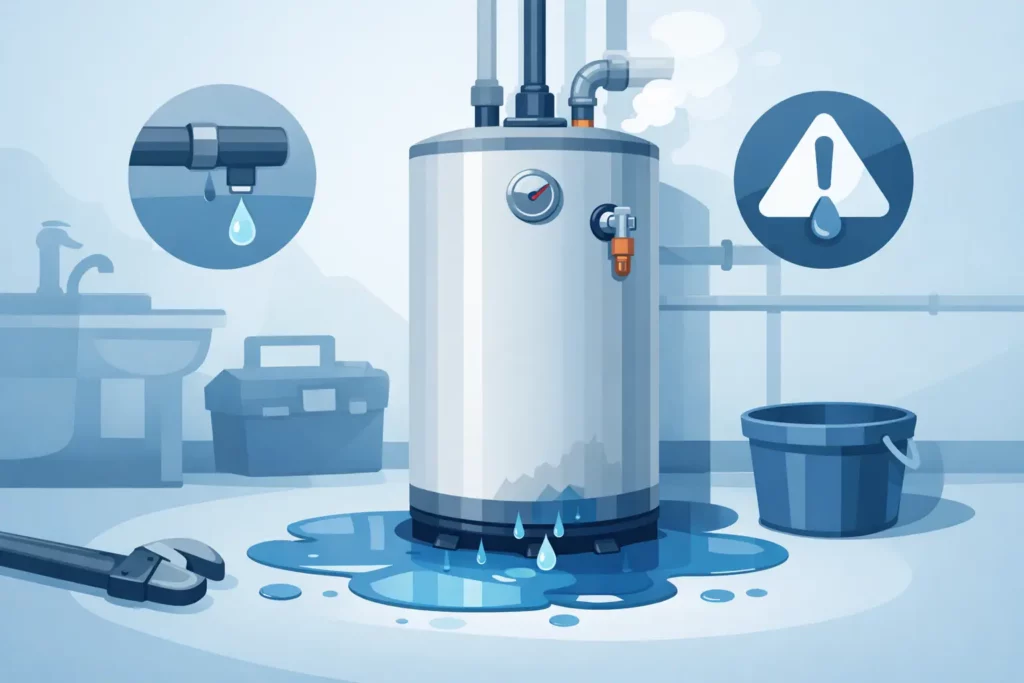
A puddle under the tank usually gets your attention fast. If you’re asking, “why is my water heater leaking,” the real concern is not just the water on the floor – it’s whether you’re dealing with a simple valve issue, a loose connection, or a tank that’s close to failure.
Some leaks are minor and repairable. Others are a sign that the unit is done and replacement is the safer, more cost-effective choice. The key is knowing where the water is coming from and acting early before it turns into floor damage, mold, or a full loss of hot water.
Why is my water heater leaking? Start with the source
Water has a way of making one problem look like another. A leak from a pipe above the heater can drip down the tank and make it seem like the unit itself has failed. Condensation can also collect around the heater and create a small pool, especially in cooler mechanical rooms.
Before assuming the worst, dry the outside of the tank and the surrounding pipes with a towel. Then watch closely to see where fresh water appears. Check the top, the side connections, the pressure relief valve, the drain valve near the bottom, and the base of the tank. That quick inspection often tells you whether you’re looking at a repair or a replacement.
The most common reasons a water heater leaks
Loose pipe connections at the top
One of the best-case scenarios is a leak from the inlet or outlet connections on top of the heater. Over time, fittings can loosen slightly from temperature changes, vibration, or age. When that happens, water may bead up around the fitting and run down the tank.
If the leak is truly at a threaded connection or flex line, a plumber can usually correct it without replacing the whole heater. The important part is confirming that the water is not actually coming from somewhere higher up or from corrosion around the connection point.
A leaking temperature and pressure relief valve
The temperature and pressure relief valve, often called the T&P valve, is a built-in safety device. It’s designed to release water if pressure or temperature inside the tank gets too high. If this valve is dripping or discharging, the valve itself may be worn out, or the heater may have a pressure problem that needs diagnosis.
This is not a part to ignore or cap off. If the valve is leaking, the cause matters. Replacing the valve may solve it, but sometimes the real issue is excessive system pressure or overheating inside the tank.
A drain valve that won’t fully close
Near the bottom of most tank-style water heaters, there’s a drain valve used for maintenance and flushing sediment. Sometimes that valve starts to drip after it has been opened and closed, or it can wear out with age.
A drain valve leak may look small, but even a slow drip can damage flooring over time. In many cases, this is repairable. The challenge is that water collecting at the bottom of the tank can also make it harder for a homeowner to tell whether the valve is leaking or the tank itself is compromised.
Sediment buildup inside the tank
In many homes, mineral content in the water leads to sediment settling at the bottom of the heater. As that layer builds up, it can cause overheating, popping sounds, reduced efficiency, and added stress on the tank. Over time, sediment contributes to corrosion and internal wear.
Sediment alone does not always cause an immediate external leak, but it often plays a role in shortening the life of the unit. If the tank has not been maintained and is already older, a leak near the base can be the final sign that the inside has deteriorated.
Corrosion in the tank
If the inner tank has started to rust through, replacement is usually the only real fix. Tank-style water heaters are built with a steel tank and a lining that helps resist corrosion, but they do not last forever. Once the protective components inside have done their job and the tank begins corroding, water can escape from the body of the heater itself.
This kind of leak often shows up at the bottom of the tank or from underneath the insulation and outer shell. If you can’t find a leaking valve or connection and the water seems to be coming from the tank body, it’s time to plan for replacement.
Cracks caused by age or thermal stress
As metal expands and contracts through years of heating cycles, older tanks can weaken. Combine that with internal pressure, sediment, and corrosion, and small cracks may develop. Once the tank shell is compromised, repairs are generally not dependable.
This is where age matters. A newer unit with a fitting issue is one thing. An older unit leaking from the tank itself is usually not worth putting money into.
How to tell if the leak is serious
Not every water heater leak is an emergency, but some definitely are. If water is actively running, the leak is worsening, or the unit is making unusual noises while leaking, treat it as urgent. The same goes for any signs of rust-colored water, visible corrosion, or water pooling rapidly around the base.
A slow drip from a connection may allow for a scheduled repair. A leaking tank usually does not improve with time. Once the tank wall gives way, the leak can go from manageable to major in a hurry.
For gas water heaters, extra caution is smart. If you notice the smell of gas, leave the area and contact the proper emergency service right away before addressing the leak itself.
What to do first when your water heater is leaking
Start by shutting off the power source if it’s safe to do so. For an electric heater, switch off the breaker. For a gas unit, turn the gas control to the appropriate setting or shut off the gas supply if you know how and it is safe. Then shut off the cold water supply valve feeding the heater.
If water is spreading, protect the surrounding area as much as possible. Towels and a wet vacuum can help limit damage while you wait for service. Take a quick photo of the leak source if it’s visible. That can be helpful when explaining the problem.
What you should not do is try a temporary patch on the tank body itself. Sealants and quick fixes rarely hold under heat and pressure, and they can create a bigger mess later.
Why age matters more than many homeowners expect
Most tank water heaters have a service life in the range of 8 to 12 years, though that varies based on water quality, maintenance, and usage. If your unit is already in that range and it starts leaking, repair options become a lot less attractive.
That doesn’t mean every older heater needs replacement the moment it drips. A bad valve or loose connector can still be repaired. But if the leak is coming from the tank, or if the heater has had repeated performance issues, replacement is usually the better investment.
Property managers and homeowners often ask whether it makes sense to repair a leaking heater just to get another year out of it. Sometimes it does. Sometimes it only delays the inevitable and increases the risk of property damage. The right answer depends on the leak location, the unit’s age, and the overall condition of the system.
When to call a plumber
If you can’t clearly identify the source of the leak, call a plumber. If the tank is leaking from the bottom, call a plumber. If the relief valve is discharging, the water is hot enough to be a safety issue, or the unit is older and showing signs of corrosion, don’t wait.
Professional diagnosis matters because the visible leak is not always the only problem. Pressure issues, improper installation, worn valves, and aging components can all be part of the picture. A proper assessment helps you avoid paying for a small repair on a unit that is already on its way out.
For homeowners and property managers in the Fraser Valley, this is exactly the kind of issue where fast, experienced service saves time and prevents bigger repair costs. A reliable plumbing team can tell you quickly whether the heater can be repaired safely or whether replacement is the smarter move.
Can a leaking water heater be prevented?
Sometimes yes, sometimes no. Regular maintenance can absolutely help extend the life of a water heater. Flushing sediment, checking the anode rod, inspecting valves, and watching for early signs of corrosion all reduce the chances of a surprise leak.
That said, no tank water heater lasts forever. Even a well-maintained unit reaches a point where replacement is the more dependable option. Prevention is really about catching problems early and getting full value from the system, not avoiding age altogether.
If your water heater is leaking, the smartest next step is not guessing – it’s finding the source and dealing with it before a small puddle turns into damaged flooring, interrupted hot water, and a much bigger repair bill.