
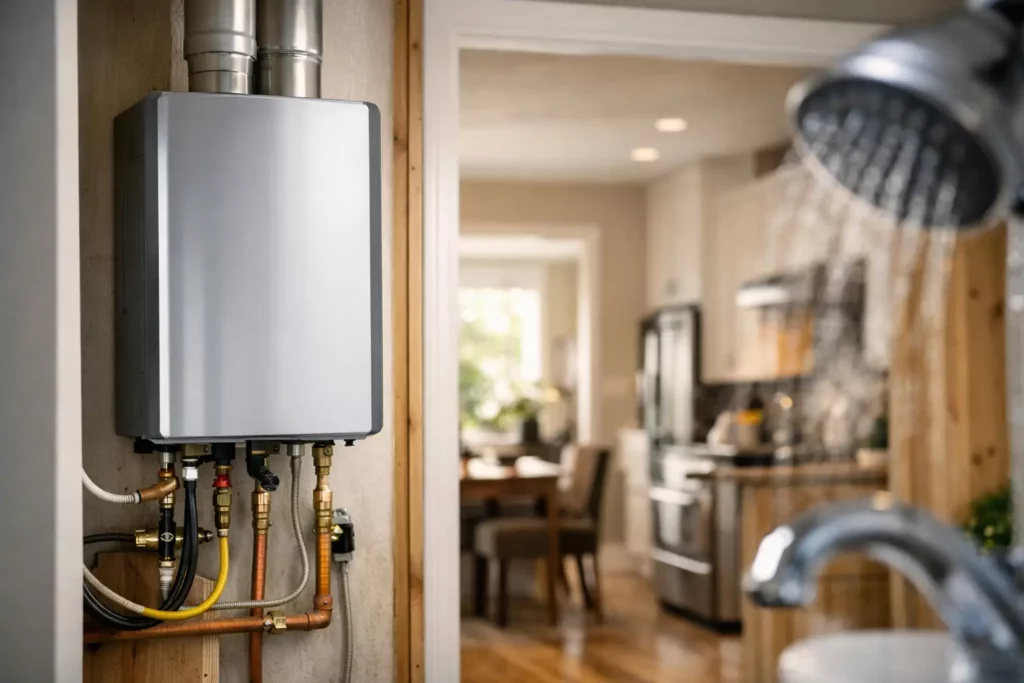
That moment when the hot water runs out halfway through a shower is usually what starts a serious tankless water heater review. Homeowners rarely shop for one because it sounds interesting. They shop because the current setup is wasting space, driving up utility bills, or failing to keep up with real daily use.
A tankless unit can be an excellent upgrade, but it is not automatically the right answer for every home. The better question is not whether tankless water heaters are good. It is whether the right unit, installed the right way, will match your home’s demand, fuel source, and plumbing layout.
Tankless water heater review: what you actually get
The main selling point is simple. A tankless water heater heats water as it passes through the unit, instead of storing a large volume of hot water in a tank. In practical terms, that means you are not limited by a tank that empties during back-to-back showers or a busy morning routine.
For many households, the biggest advantage is consistency. If the unit is sized properly, hot water recovery feels nearly endless. That is especially useful in larger homes, homes with high-demand bathrooms, or properties where laundry, dishwashing, and showers often happen at the same time.
There is also a space benefit. Tankless units mount on the wall and free up floor space that a traditional tank would occupy. In tighter mechanical rooms, utility closets, or smaller homes, that matters more than people expect.
Energy efficiency is another real benefit, but it should be viewed clearly. A tankless system avoids the standby heat loss that comes with storing hot water all day. That can lower operating costs, especially in homes with moderate or variable hot water use. The savings are real, but they do not erase the upfront installation cost overnight.
Where tankless systems perform well
In the right home, tankless performance is strong. Gas-fired units in particular tend to deliver the flow rates most families expect. They are often a good fit for households that want dependable hot water for multiple fixtures without the stop-and-wait cycle of a tank reheating.
They also make sense in homes where longevity matters. A quality tankless system can last longer than a standard tank water heater when it is installed properly and maintained on schedule. For owners planning to stay in the home for years, that longer service life can help justify the higher initial price.
Property managers and builders often like tankless systems for a different reason. They support a cleaner layout, can be a selling point for tenants or buyers, and offer a more premium mechanical setup. That said, premium only works when performance is reliable. Poor sizing or rushed installation usually turns a good product into a frustrating one.
The trade-offs most reviews skip
This is where a useful tankless water heater review needs to be honest. Tankless is not a magic upgrade.
First, the upfront cost is higher. The unit itself costs more than many traditional tanks, and installation can add significantly to the total. Venting, gas line sizing, electrical work, condensate management, and plumbing changes may all be part of the job. If your home is not already set up for a tankless system, the labor can be a bigger factor than the heater itself.
Second, output depends on demand and incoming water temperature. In colder climates or winter conditions, groundwater enters the unit colder, and that affects how much water the heater can raise to your target temperature at one time. This is why a unit that looks great on paper can still disappoint in actual use if it is undersized.
Third, there can be a slight delay before hot water reaches the fixture. A tankless unit does not instantly put hot water at the tap. It still has to travel through the pipes. Some homeowners expect instant hot water and are disappointed when they realize that tankless does not fix pipe distance.
Maintenance is another point people underestimate. Tankless units need periodic service, especially in areas with hard water. Mineral buildup can reduce efficiency and affect performance over time. If the system is neglected, it will not deliver the lifespan or savings people expect.
Gas vs. electric in a tankless water heater review
For whole-home use, gas tankless models usually make the most sense. They provide stronger flow rates and are better suited to homes with several simultaneous hot water demands. If you want one unit to serve showers, sinks, laundry, and kitchen use without compromise, gas is typically the better fit.
Electric tankless units can work well in smaller applications, additions, or point-of-use situations. They are compact and can be simpler in some installations, but whole-home electric tankless systems often require major electrical capacity. In many houses, that upgrade alone changes the math.
So the better comparison is not which technology sounds better. It is which one your home can support efficiently and affordably. A good installer will look at service capacity, fixture demand, and actual household usage before making a recommendation.
Sizing matters more than brand names
Homeowners often start by asking which brand is best. The more important question is whether the unit is sized correctly.
Tankless water heaters are rated by flow rate, usually gallons per minute, and by how much they can raise incoming water temperature. Those numbers have to line up with your busiest real-life moments. If two showers run while the dishwasher starts and someone uses a bathroom sink, the unit must keep pace with that demand.
This is where professional planning matters. An undersized system may work fine for one shower and struggle the moment a second fixture turns on. An oversized system can mean paying more than necessary. The goal is not to buy the biggest unit. It is to install the right one for the house.
Installation quality makes or breaks the result
A well-made tankless water heater can still perform poorly if the installation is careless. This is not a swap where the old tank comes out and the new box goes in without much thought.
Proper venting is critical on gas models. Gas supply must be adequate. Water lines need to be installed cleanly and according to code. In some homes, pressure considerations, recirculation options, and isolation valves should be part of the plan. These details are not extras. They affect serviceability, safety, and day-to-day performance.
This is also why homeowners should be cautious about choosing strictly on sticker price. A lower quote can leave out necessary upgrades that show up later as performance issues or added costs. Good installation work is usually quieter, cleaner, and less visible because the system simply works the way it should.
When a tankless water heater is worth it
A tankless system is often worth it when your household uses a lot of hot water, your current tank struggles to keep up, or you are already planning a major mechanical upgrade. It also makes sense when you want a longer-term solution and are willing to invest upfront for better efficiency and space savings.
It can be especially appealing during remodels, additions, or new construction, when the surrounding plumbing and fuel setup are already being addressed. In those cases, the installation is often more straightforward than retrofitting an older home around a new system.
If you are in a place like Chilliwack or nearby communities where households often balance family demand, utility costs, and long-term home upgrades, tankless can be a smart choice. But it still comes down to the house, not the trend.
When a traditional tank may still be the better call
There are cases where a standard tank water heater remains the practical option. If upfront budget is the main concern, a tank system is usually less expensive to purchase and install. If your existing setup is straightforward and meeting your household’s needs, switching to tankless may not produce enough benefit to justify the extra cost.
Older homes can also be less tankless-friendly if gas line upgrades, venting changes, or electrical improvements are extensive. In that situation, a homeowner may be better served by installing a high-quality traditional tank or considering a hybrid option instead.
There is no shame in that answer. The right plumbing decision is the one that fits the property and holds up over time.
Final take on this tankless water heater review
Tankless water heaters earn their reputation when the system is sized correctly, installed professionally, and matched to the home’s real hot water demand. They offer strong performance, better space use, and solid efficiency, but they also require a higher upfront investment and more planning than many homeowners expect.
If you are comparing options, the smartest next step is not chasing marketing claims or online ratings alone. It is getting a clear assessment of your home’s demand, fuel capacity, and installation requirements so the system you choose performs well on day one and keeps doing its job years later.