
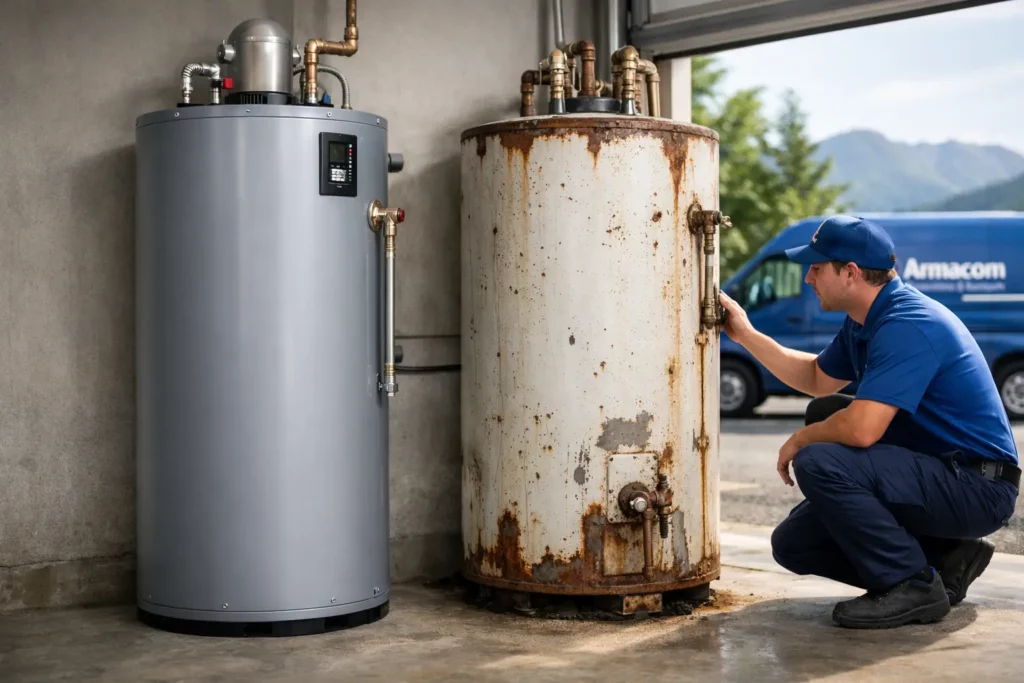
A hot water tank rarely fails at a convenient time. It starts with a small puddle near the base, rusty water at a faucet, or a shower that turns cold halfway through. When weighing a new hot water tank versus an old tank in Chilliwack, the right answer is not always immediate replacement. Age, the type of problem, the condition of the tank, and the cost of a proper repair all matter.
As a plumber, I look beyond whether the unit is making hot water today. The more useful question is whether it can continue doing so safely and reliably without putting your home, tenant, or business at risk of water damage.
When an Old Hot Water Tank Is Still Worth Repairing
Not every hot water problem means the tank itself is finished. A relatively newer tank with a failed thermostat, heating element, gas control component, or pressure relief valve may be a sensible repair candidate. These parts can wear out while the tank body and internal lining remain in good condition.
For electric tanks, loss of hot water may come from a failed element or thermostat. If the tank produces some hot water but not enough, one element may have failed or be covered in mineral buildup. A qualified plumber can test the components and confirm the cause rather than guessing.
Gas tanks can have issues with the pilot system, burner assembly, thermopile, thermostat, or venting. These need proper diagnosis. Gas controls and vent connections are not homeowner repair items. A repair may be reasonable when the unit is not old, there is no evidence of leakage, and replacement parts are available.
An old tank can also appear to be failing when the real issue is elsewhere. A leaking pipe connection, a worn shutoff valve, or a dripping temperature and pressure relief valve can often be repaired without replacing the appliance. This is why a site inspection matters. Replacing a tank will not solve a plumbing leak beside the tank.
New Hot Water Tank Versus Old Tank in Chilliwack: The Turning Point
The tank itself is the deciding factor. Once water is leaking from the lower body of a conventional storage tank, replacement is normally the practical path. The steel tank is protected by an internal lining and sacrificial anode rod, but that protection does not last forever. When the tank wall has corroded through, there is no durable repair that restores its integrity.
Age is also a major consideration. Many conventional hot water tanks provide dependable service for roughly eight to 12 years, though actual lifespan varies with water conditions, maintenance history, usage, installation quality, and the model. A tank nearing or beyond that range may still run, but an expensive repair becomes harder to justify.
A repair that costs a modest amount on a five-year-old tank can be good value. The same repair on an 11-year-old tank, especially one showing corrosion or performance issues, may simply postpone an emergency replacement. For landlords and property managers, this distinction is especially important. A planned replacement is far easier to coordinate than a tank failure in an occupied suite.
Signs Replacement Is Usually the Better Choice
A few warning signs deserve prompt attention. These do not all mean immediate failure, but they should not be ignored:
- Water collecting beneath the tank or moisture coming from the tank body
- Rust streaks, heavy corrosion, or swelling around the lower portion of the tank
- Discolored hot water that persists after checking for other plumbing causes
- Rumbling, popping, or banging caused by heavy sediment buildup
- Hot water that runs out much faster than it used to
- Repeated repairs on an aging unit
Sediment deserves particular mention. Over time, minerals settle at the bottom of a tank. A small amount is common, but a thick layer makes the burner or electric elements work harder and reduces the amount of available hot water. It can also create noise and contribute to premature wear. Flushing can help in some cases, but it will not reverse internal corrosion or repair a damaged tank lining.
The Real Cost Is More Than the Repair Bill
Homeowners often compare the repair estimate to the price of a new tank. That is necessary, but it is not the full comparison. Consider the risk and inconvenience attached to keeping the old unit in service.
A failed tank can release a significant amount of water before someone notices it. In a finished basement, utility closet, condo unit, restaurant, or commercial space, the resulting damage and downtime can quickly outweigh the savings from delaying replacement. If your tank is in an area where a leak could affect flooring, walls, stored items, or another unit, reliability has real value.
There is also operating efficiency. New tanks are generally better insulated than much older equipment, and a properly sized replacement can reduce standby heat loss. That does not mean every new tank will create dramatic utility savings. The benefit depends on the age and condition of the existing unit, household demand, and fuel source. The strongest reason to replace is usually dependable hot water and reduced failure risk, with efficiency as a useful secondary benefit.
For a commercial property, capacity matters just as much as efficiency. A tank that once served a small office may not be adequate after occupancy or hot water usage increases. Installing the same size without reviewing actual demand can leave staff, tenants, or customers short on hot water during busy periods.
Choosing the Right Replacement Tank
A new tank should be selected for the building, not just the space where the old one sits. Capacity, fuel type, recovery rate, venting requirements for gas units, available clearances, and household usage all need to be reviewed. A family with multiple morning showers may need a different setup than a one-bedroom rental unit or a small business washroom.
It is also worth checking the surrounding plumbing during replacement. Older shutoff valves, corroded fittings, deteriorated drain pans, and questionable connections can turn a straightforward installation into a future leak call. Addressing visible issues while the tank area is accessible can prevent a return visit later.
For gas hot water tanks, the installation must account for the existing venting arrangement and gas connection. For electric models, wiring and electrical protection must be suitable for the unit. These details affect safety, code compliance, and performance, which is why a replacement should be installed with precision rather than treated as a simple appliance swap.
Is a Tankless Water Heater a Better Alternative?
A tankless water heater can be a good option for some Chilliwack homes and businesses, but it is not automatically the best replacement for every old tank. Tankless units heat water on demand, which can provide a continuous supply when the system is properly sized. They also avoid storing a large volume of heated water.
The trade-off is installation complexity. A tankless conversion may require changes to gas piping, venting, water piping, or electrical supply, depending on the property and equipment selected. The upfront cost can be higher than replacing a conventional tank. For a household that wants a straightforward, cost-conscious replacement, a new storage tank may be the better fit. For a property with high or ongoing hot water demand, tankless may be worth assessing carefully.
Do Not Wait for a Full Failure
If you see active leaking, smell gas near a gas-fired tank, hear unusual burner behavior, or have no hot water at all, arrange professional service promptly. Turn off the water supply to an actively leaking tank if it is safe to do so, and protect nearby belongings from water damage. Do not cap, plug, or disable a temperature and pressure relief valve.
For a tank that is simply getting old, planning ahead is the better approach. Check its age from the manufacturer label, watch for corrosion, and pay attention to changes in hot water capacity. A professional assessment can tell you whether a targeted repair is still worthwhile or whether replacement is the more dependable investment.
Armacom Plumbing & Heating can inspect the condition of your existing unit, explain the practical options, and install a properly sized replacement when the time is right. A planned decision today is often the easiest way to avoid a cold shower and a water damage problem tomorrow.